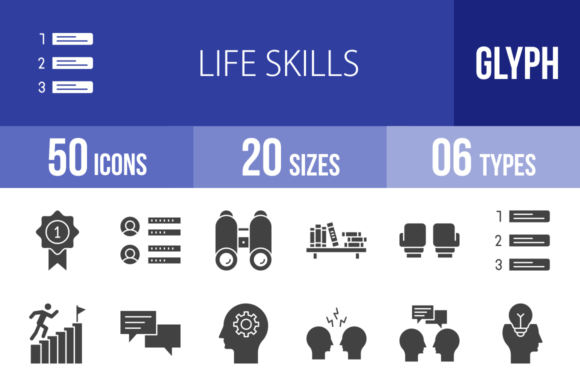
Visualizing Competence: How 50 Life Skills Glyph Icons Are Reshaping Digital Communication
In an era defined by information overload and shrinking attention spans, the ability to convey complex concepts instantly is not just a luxury—it is a necessity. For professionals, educators, and app developers, the challenge lies in bridging the gap between abstract "soft skills" and concrete user interface elements. Enter the 50 Life Skills Glyph Icons, a comprehensive suite of visual assets designed to articulate the nuances of human development, cognitive function, and personal growth. This collection is more than just a set of graphics; it represents a shift toward more empathetic and intuitive design language in both digital and print landscapes.
The Rise of Visual Semantics in Professional Development
The modern workforce is undergoing a massive transformation. We are moving away from rigid, hard-skill hierarchies toward fluid, competency-based models where Life Skills like Empathy, Conflict Resolution, and Self-confidence are valued as highly as technical proficiency. However, these concepts are inherently abstract. How does one visually represent "Cognitive" processing or "Strategy" on a mobile dashboard without resorting to clichés?
This is where the 50 Life Skills Glyph Icons bridge the gap. By utilizing a design philosophy rooted in clarity and universal recognition, these icons provide a shared vocabulary for the education and corporate training sectors. When a user opens a mental wellness application or a corporate learning management system (LMS), they expect immediate visual cues. They need to see an icon for Healthy Mind or Wellness that feels intuitive, not confusing. This collection addresses that need by offering symbols that are instantly recognizable, thereby reducing cognitive load and enhancing user experience (UX).
Engineering for the Multi-Platform Reality
One of the most significant hurdles in contemporary design is the fragmentation of devices. A creator might be designing a presentation for a 4K projector, a mobile app interface for a 5-inch screen, and a printed pamphlet all within the same week. The 50 Life Skills Glyph Icons are engineered specifically to solve this workflow bottleneck.
The relevance of this asset pack lies in its technical versatility. The provision of 20 different PNG sizes—ranging from the microscopic 16x16 pixels suitable for favicons and dense data tables, up to 96x96 pixels for high-resolution mobile displays—ensures that icons like Leadership or Creativity remain crisp and legible regardless of the medium. Furthermore, the inclusion of vector formats such as AI, CDR, EPS, and SVG means these icons are infinitely scalable. Whether printed on a massive banner or rendered on a smartwatch, the integrity of the design remains intact. This adaptability is crucial for agencies and freelancers who need to maintain brand consistency across diverse touchpoints.
Decoding the Visual Language: Symbolism and Usability
The true value of this icon set lies in the thoughtful curation of its subject matter. The selection covers a broad spectrum of human interaction and personal development, moving beyond generic stock imagery to offer specific, actionable symbolism. Let us explore how these icons fit into practical applications:
Navigating Complexity and Decision Making
In project management and personal development apps, users often need visual representations of obstacles and solutions. The Maze and Puzzle Part icons perfectly encapsulate the feeling of navigating complex problems. Similarly, the Scales icon is universally understood to represent Equality or balance, making it ideal for HR platforms focusing on diversity and inclusion. When a user encounters a Challenge, seeing a visual representation of a Target or a Goal provides psychological motivation to proceed.
Communication and Social Dynamics
Effective communication is the bedrock of success. The inclusion of Speech Bubble, Conversation, and Chat icons allows designers to differentiate between various modes of interaction. For example, a mental health app might use the Empathy or Sensitivity icons to denote support groups, while a business tool might use Strategy and Process to outline workflow discussions. The Conflict icon is particularly useful in educational materials regarding negotiation or sociology, providing a visual shorthand for tension without using aggressive imagery.
Cognitive and Emotional Intelligence
As the world embraces the importance of Emotional Intelligence (EQ), the demand for icons representing internal states has skyrocketed. The Emotions icon serves as a catch-all, but the set goes deeper. The Brain (implied by Cognitive), Thinking, and Idea (represented by the Lightbulb) allow for a granular depiction of the thought process. For coaching platforms, the Selfconfident and Thinking icons are indispensable tools for visualizing a client's journey from doubt to clarity.
Meeting the Demand for "Human-Centric" Design
Why are professionals paying such close attention to assets like the 50 Life Skills Glyph Icons? The answer lies in the "Human-Centric" design trend. Technology is no longer just about efficiency; it is about connection. Users are gravitating toward interfaces that feel personal and understanding.
When a freelancer designs a website for a life coach or a therapist, using generic "business" icons feels cold and disconnected. Using specific glyphs like Wellness, Touch, or Environment signals to the visitor that the service provider understands the nuances of their needs. This specificity builds trust. The Magnet icon, for instance, can be used creatively to represent attraction or influence in marketing materials, while the Hourglass speaks to patience and time management—crucial skills in a fast-paced world.
Technical Excellence: The Grid System
For the design purist and the practical developer alike, consistency is king. The 50 Life Skills Glyph Icons are designed using a Pixel Perfect Grid System. This is not merely an aesthetic choice; it is a technical requirement for modern UI design. When icons are aligned to a grid, they sit harmoniously alongside text and other UI elements.
Consider the Web Browser icon or the Portfolio icon. In a crowded navigation bar, these icons must be optically balanced. The grid system ensures that the Bookshelf icon has the same visual weight as the Binoculars icon, even if their shapes differ. This attention to detail saves developers hours of manual adjustment, allowing them to focus on functionality rather than pixel-pushing.
The Future of Visual Assets in the Creator Economy
The creator economy is booming, and with it comes a need for high-quality, versatile assets. We are seeing a trend where templates and design kits are no longer static. They are dynamic toolkits that empower entrepreneurs to launch products faster.
The 50 Life Skills Glyph Icons fit perfectly into this ecosystem. An entrepreneur launching a new productivity app can use the Strategy and Ruler icons for their marketing landing page, then use the same icon set within the app interface for the settings menu. The availability of 6 different formats ensures that whether the asset is being used in a PowerPoint presentation to investors or coded into a native iOS app, the quality remains professional.
Practical Applications Across Industries
The utility of this collection extends far beyond app development. Here is how different sectors can leverage these icons:
- Education: Teachers can use the Mortarboard, Bookshelf, and Question (implied by the nature of inquiry) icons to create engaging worksheets and digital learning modules. The Problem and Puzzle Part icons are excellent for math and logic exercises.
- Corporate Training: HR departments can utilize Leadership, Teamwork (implied by Man/Woman), and Goal icons to structure training manuals. The Trophy and Award icons serve as gamification elements to reward employee progress.
- Healthcare & Therapy: The Healthy Mind, Wellness, and Touch icons provide a gentle, approachable visual language for patient intake forms and health tracking apps.
- Marketing & Advertising: Marketers can use the Magnifying Glass for SEO content, the Magnet for lead generation campaigns, and the Lightbulb for innovation blogs.
Conclusion: A Toolkit for the Modern Age
The shift toward a skills-based economy requires tools that can keep up with our evolving understanding of success. The 50 Life Skills Glyph Icons are not just decorative elements; they are functional communication tools that enhance clarity, improve user engagement, and bridge the gap between abstract concepts and digital interfaces.
By offering a robust technical package—including AI, CDR, EPS, JPG, PNG, and SVG formats—alongside a thoughtful selection of life-centric subjects, this collection empowers creators to build more meaningful digital experiences. Whether you are a developer coding the next big wellness app, a teacher designing a curriculum on emotional intelligence, or a marketer crafting a campaign about personal growth, these icons provide the visual vocabulary you need to communicate effectively in the modern world.