Integrating the 10 Artificial Intelligence Icons Bundle into Your Digital Workflow
In the current landscape of digital design and development, visual communication is not merely aesthetic; it is a critical component of user experience and information architecture. For professionals ranging from UI/UX designers to content creators and corporate educators, the challenge often lies in translating complex, abstract concepts—such as machine learning, neural networks, and data analytics—into intuitive visual cues. This is where a specialized asset like the 10 Artificial Intelligence Icons Bundle becomes a strategic tool rather than just a decorative element. By providing a cohesive set of symbols designed for high-resolution and scalable use, this bundle addresses the specific need for clarity in technology-driven projects.
The Strategic Role of Visual Assets in Technology Projects
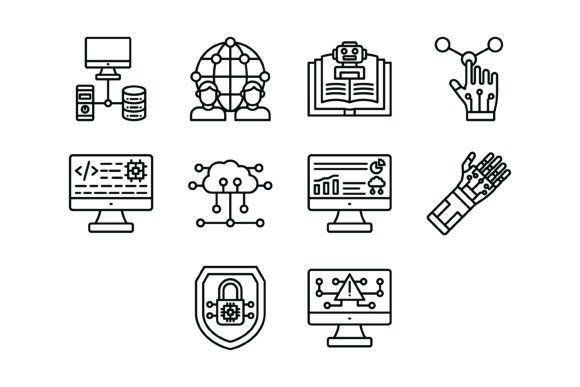
When initiating a project involving AI or tech-centric themes, the planning phase requires more than just code and copy; it demands a unified visual language. The 10 Artificial Intelligence Icons Bundle fits directly into the pre-production and design stages of a workflow. Before a single line of code is written or a slide deck is finalized, stakeholders must agree on how to visualize data points, security protocols, and interactive elements. Using generic icons often leads to visual dissonance, where the imagery does not match the sophistication of the technology being described. By integrating a purpose-built set, such as the Technology Icon or the Global Network Icon, you ensure that the visual hierarchy aligns with the technical complexity of your subject matter.
For the entrepreneur or small business owner pitching a new AI-driven solution, these assets are invaluable during the storytelling phase. A pitch deck utilizing the Machine Learning Icon and the Data Analytics Icon immediately signals to investors or clients that the presenter understands the underlying mechanics of their product. It moves the presentation from a generic template to a specialized pitch, grounding abstract ideas in recognizable imagery. This preparation step is crucial for establishing credibility and authority—key components of the E-E-A-T (Experience, Expertise, Authoritativeness, and Trustworthiness) framework that Google prioritizes.
Technical Versatility and File Compatibility
A significant hurdle in the design process is the friction caused by file incompatibility. A workflow can grind to a halt if a designer needs an SVG for web scaling but only has a raster JPG. The 10 Artificial Intelligence Icons Bundle is engineered to eliminate this bottleneck by including AI, EPS, JPG, PNG Transparent Background, and SVG formats.
Understanding where each format fits into your process is essential for efficiency:
- SVG (Scalable Vector Graphics): This is the primary format for web and mobile application development. Because the 10 Artificial Intelligence Icons are designed as line icons, SVGs allow developers to scale the graphics infinitely without pixelation. This is particularly vital for the Coding Icon and Cloud Computing Icon, which are frequently used in responsive navigation bars or feature lists that must look crisp on both a 4K monitor and a smartphone screen.
- AI and EPS (Vector Source Files): These formats are the domain of the graphic designer. If you need to modify the stroke weight, change the color palette to match a specific brand guideline, or combine the Bionic Arm Icon with other graphic elements, you would use these files. They allow for deep customization during the creative process.
- PNG (Transparent Background): For content creators, bloggers, and educators, the PNG format is often the workhorse. It allows for drag-and-drop functionality into slide presentations, blog headers, or video editing software without the need to mask out a white background. The Warning Icon or Security Icon can be quickly placed over a background image in a blog post about cybersecurity threats without complex editing.
- JPG: While less flexible than PNG due to the lack of transparency, JPGs are useful for quick previews, mood boards, or contexts where file size is a priority and transparency is not required.
By offering this range, the bundle ensures that the transition from concept to execution is seamless, regardless of the software stack being used by the team.
Practical Implementation: From Wireframe to Production
The usability of the 10 Artificial Intelligence Icons Bundle extends across various stages of production. Consider the workflow of a mobile app developer building a dashboard for an IoT (Internet of Things) system.
Phase 1: Wireframing and Prototyping
During the low-fidelity wireframing stage, developers and UX designers need to establish the layout of information. The Interaction Icon and the Machine Learning Icon can be used as placeholders to define where visual indicators will guide the user. Because the icons are designed for "maximum usability," they possess a clarity that helps stakeholders understand the intended function of a button or a data card without getting distracted by high-fidelity details too early in the process.
Phase 2: UI Integration and Development
As the project moves into the high-fidelity prototype and development phase, the requirement shifts to precision. The SVG versions of the icons are integrated into the codebase. For a feature section explaining the app's capabilities, a developer might use the Global Network Icon next to a description of connectivity, and the Cloud Computing Icon for cloud storage features. The "line icon" style ensures that these elements remain legible even at smaller sizes, such as in the bottom navigation bar of a mobile interface.
Phase 3: Marketing and Documentation
Once the product is ready, the marketing team takes over. They require assets for landing pages, social media graphics, and user manuals. The Security Icon becomes a badge of trust on a pricing page, while the Data Analytics Icon highlights the reporting features in a promotional flyer. Because the bundle is "Ready to use for all devices and platforms," the marketing team does not need to request custom assets from the design team, significantly speeding up the time-to-market.
Enhancing Educational and Corporate Training Materials
Outside of product development, the 10 Artificial Intelligence Icons Bundle serves a vital function in the education sector. Educators and corporate trainers often struggle to make technical subjects accessible. A slide deck explaining the concept of a "neural network" can be dry and text-heavy. By incorporating the Bionic Arm Icon or the Technology Icon, the instructor can create visual anchors that help students retain information.
For instance, a module on "The Ethics of AI" could utilize the Warning Icon to denote sections discussing bias or risks, while the Interaction Icon could introduce topics on Human-Computer Interaction (HCI). The ability to easily edit these icons means an educator can create a consistent color-coding system across a semester's worth of materials, reinforcing learning through visual consistency.
Workflow Optimization and Long-Term Usability
One of the most overlooked aspects of asset management is organization. A common pain point for freelancers and agencies is the accumulation of disparate assets that do not match in style or quality. Adopting a bundle like this enforces a design system from the outset.
Because the bundle includes 100 vector icons (though specifically highlighting these 10 AI-focused ones), it suggests a broader ecosystem of compatible graphics. This is beneficial for long-term projects. If a client expands their scope from a simple app to a complex enterprise platform, the designer can rely on the same family of icons to maintain visual cohesion. The "Easy to edit and scale" feature ensures that as the brand evolves—perhaps moving from a dark mode to a light mode interface—the icons can be adapted in minutes, not hours.
Furthermore, the inclusion of the Coding Icon and Interaction Icon makes this bundle particularly useful for internal documentation. Developer wikis and technical specifications often require visual aids to break up dense text. Using these icons to label different sections—such as "API Endpoints" or "User Input Fields"—improves the scannability of the document, allowing teams to find information faster and reducing cognitive load.
Conclusion: A Practical Asset for Modern Creators
The 10 Artificial Intelligence Icons Bundle is more than a collection of graphics; it is a utility designed to bridge the gap between complex technology and human understanding. Whether you are a startup founder validating a concept, a developer building a responsive interface, or an educator simplifying a curriculum, these icons provide the visual vocabulary necessary to communicate effectively. By integrating these assets into your workflow, you ensure that your projects are not only functional but also visually coherent and professionally presented across all platforms.