The Essential Guide to the Modern Blackboard Icon: Formats, Usability, and Design Integration
In the vast ecosystem of digital design, few symbols carry as much universal recognition as the blackboard. It evokes memories of education, brainstorming, and the organic flow of ideas. However, in the modern era of User Interface (UI) and User Experience (UX) design, the blackboard has evolved. It is no longer just a slab of slate; it is a glyph icon—a standardized, scalable, and essential tool for web developers, app creators, and graphic designers. This article explores the significance of the blackboard glyph icon, the technical necessity of diverse file formats, and how these assets are revolutionizing the way we create digital templates and presentations.
Understanding the "Glyph" and Its Visual Language
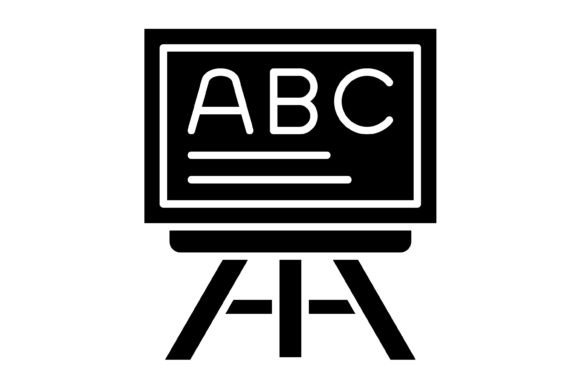
Before diving into file specifications, it is crucial to understand what a glyph is. In typography and design, a glyph is the specific visual representation of a character. When we refer to a "Blackboard Glyph Icon," we are describing a simplified, stylistic representation of a blackboard designed to function as a recognizable symbol within a larger interface.
Unlike a detailed illustration, a glyph is stripped of unnecessary complexity. Its purpose is immediate recognition. Whether a user is scrolling through an education mobile app or browsing a website for a teaching tool, the blackboard icon must convey "learning" or "writing" in a split second. This is the foundation of "maximum usability." If an icon requires the user to pause and think about what it represents, it has failed its primary function.
The Power of Versatility: The 5-Format Zip File
One of the most common pain points for designers and developers is receiving an asset in a format that doesn't fit their workflow. A web developer might need a specific type of vector code, while a print designer requires high-resolution raster images. To solve this, professional icon sets—such as the one described here—are distributed in a comprehensive package containing five distinct formats: AI, EPS, JPG, PNG, and SVG.
1. The Vector Giants: AI and EPS
The Adobe Illustrator (AI) and Encapsulated PostScript (EPS) formats are the heavy lifters of the design world. These are vector formats, meaning they are not made of pixels but of mathematical paths.
- Editability: With an AI file, a designer can open the blackboard icon and change the color, line thickness, or shape entirely. You can turn the "chalk" writing into a different font or resize the board without losing quality.
- Scalability: Because they are vectors, these files can be scaled to the size of a billboard or a business card without ever becoming pixelated or blurry. This is essential for Templates and Print materials.
2. The Web Standard: SVG
The Scalable Vector Graphics (SVG) format is the bridge between graphic design and coding. It is an XML-based vector image format for two-dimensional graphics.
- Performance: Unlike heavy image files, SVGs are lightweight code. They load incredibly fast, which is a critical factor for Website SEO and performance.
- Responsiveness: SVGs are the gold standard for Mobile Apps and responsive websites. They adapt to any screen resolution—whether it is a standard monitor or a 4K smartphone screen—ensuring the blackboard icon looks crisp on all devices.
3. The Raster Essentials: JPG and PNG
While vectors are superior for editing, raster images (pixels) are often necessary for specific applications.
- JPG (Joint Photographic Experts Group): This format is widely used for web photography and simple graphics. It is excellent for Presentations (like PowerPoint or Keynote) where file size needs to be manageable and the icon does not require a transparent background.
- PNG (Portable Network Graphics): This is the hero format for web designers. The key feature here is the Transparent Background. A blackboard icon with a transparent background can be placed over any color, pattern, or photograph without having an ugly white box around it. This is vital for layering designs in Illustrations and complex web layouts.
Designing for the Ecosystem: Usability and Platforms
The modern digital landscape is fragmented. A user might access a service on an iPhone, switch to a Windows desktop, and then view a printed brochure. The blackboard glyph icon must function seamlessly across this entire ecosystem.
Mobile Apps and Websites
In UI design, consistency is king. When a developer uses the blackboard icon for an "Education" category in a mobile app, the icon must align with the operating system's design language. A high-quality glyph icon is designed with "pixel-perfect" alignment, meaning the lines sit perfectly on the pixel grid to prevent blurring on high-density screens. The inclusion of SVG and Transparent PNG formats ensures that the icon integrates perfectly with HTML5 and CSS frameworks, allowing for animations and hover effects that make websites feel interactive and alive.
Print and Presentation
When creating a Presentation for a business meeting or an educational seminar, visual quality is paramount. Using a low-resolution icon on a 4K projector screen results in jagged edges that look unprofessional. By utilizing the AI or EPS files from the zip package, a presenter can ensure the blackboard icon remains sharp and professional. Similarly, for print materials—such as flyers for a tutoring service or a textbook cover—the vector formats ensure that the ink prints with smooth curves rather than stair-stepped pixels.
The "100 Vector Icons" Advantage
The value of a single icon increases when it is part of a cohesive system. A pack containing 100 vector icons offers a complete visual vocabulary. While our focus is the blackboard, imagine that pack also containing a ruler, a graduation cap, a book, and a pencil.
When these icons share the same style—be it line art, flat design, or filled glyphs—they create a unified aesthetic for a brand. For a teacher building a website or a startup developing an EdTech app, having access to a library of 100 matching icons means they can design their entire interface without hunting for disparate assets that clash with one another. This saves time, reduces design costs, and creates a more pleasant experience for the end-user.
Practical Applications: From Classrooms to Corporate Boards
How does a blackboard icon fit into modern life? The applications are broader than one might think.
- Educational Technology (EdTech): This is the most obvious application. Apps used for virtual learning, grading systems, or student portals use the blackboard icon to signify the "classroom" or "course" section of the app.
- Corporate Training: In the corporate world, "Training" is a constant requirement. HR platforms use blackboard icons to mark mandatory compliance training or skill-building workshops.
- Content Creation: YouTubers and bloggers who create tutorial content often use blackboard graphics in their thumbnails or headers to signal to the viewer that they are about to learn something new.
- Event Management: Conference organizers might use the icon on signage to indicate a workshop or a breakout session where active participation (like writing on a board) is encouraged.
Clarifying Common Misconceptions
There are a few misunderstandings regarding digital icons that are worth addressing.
- "Resizing is always easy": While vectors (AI, EPS, SVG) resize infinitely, raster images (JPG, PNG) do not. Enlarging a JPG blackboard icon to 500% will result in a blurry mess. This is why the zip file includes both; you use the vector for resizing and the raster for quick drops into documents.
- "All icons are free to use": It is important to note that professional icon packs are licensed products. Even if they are "ready to use," they usually come with specific licensing terms regarding how many projects they can be used in or whether attribution is required.
- "PNG and JPG are interchangeable": They are not. As mentioned, PNG supports transparency; JPG does not. If you try to put a blackboard JPG on a blue website background, you will have a white square blocking the blue. Always use PNG for web overlays.
The Future of Iconography
As technology moves toward Augmented Reality (AR) and Virtual Reality (VR), the role of the glyph icon will evolve. However, the core principles remain. A blackboard icon in a VR classroom still needs to be recognizable, scalable, and stylistically consistent. The "100 vector icons" pack represents not just a set of images, but a toolkit for visual communication.
By providing files that are "Easy to edit and scale," designers empower creators to adapt these visuals to whatever medium comes next. Whether it is a smartwatch app, a massive digital billboard, or a holographic display, the blackboard glyph remains a timeless symbol of knowledge.
Conclusion
The blackboard glyph icon is more than just a picture of a piece of wood with chalk. It is a carefully engineered digital asset designed for the complexities of modern cross-platform communication. By utilizing a comprehensive package that includes AI, EPS, JPG, Transparent PNG, and SVG formats, users ensure that their projects—whether mobile apps, websites, or print presentations—maintain the highest standards of quality and professionalism. The availability of 100 vector icons ensures that the visual language is consistent, scalable, and ready to educate and inspire across any device.